FINx Your Questions Answered: Skills
10 Feb 2026

 Gregg HutchingsProgramme Director, Financial Services Skills Commission
Gregg HutchingsProgramme Director, Financial Services Skills Commission
Gregg joined the FSSC as Programme Director in November 2021. Gregg oversees the FSSC workstreams and projects, working closely with members to develop products and services. Previously, Gregg was Head of Policy and Stakeholder Engagement at the FSCB where he led on policy development relating to organisational culture and its development. Prior to this, Gregg has held a range of policy and project management roles across the public, private and not-for-profit sectors. When not running around the park with his kids, Gregg enjoys playing the trumpet, badly.
Should the Government be investing in digital training both at school and in higher education?
Against a backdrop of constantly evolving technology and change, our sector would benefit if schools and higher education offered additional support to young people. This might include developing digital literacy and encouraging the development of key technical skills outlined in our Future Skills Framework, such as data analysis and software development. It’s also important for the education sector to develop behaviours such as critical thinking, relationship management or empathy (also in our framework) as these work to amplify and govern the value of technical skills.
If the expectation is a fundamental change in how work is done, why are we talking about a statistical analysis of skills in current job postings?
It’s a good point but we’re not there yet. Job postings are not a perfect overview of how work is changing but they are an indicator of what firms need across the sector, now and in the near future. This tells us which skills firms are looking for and where their skill gaps lie. If firms can adopt a skills-first approach to hiring, they can plug even more gaps. As more technology is implemented we may see more of an evolution, or augmentation, in the skills required to fulfill a role rather than a fundamental shift in roles, hence the focus on skills.
Can you give a sense of investment that is required to keep the workforce AI-ready? (% of spend etc.)
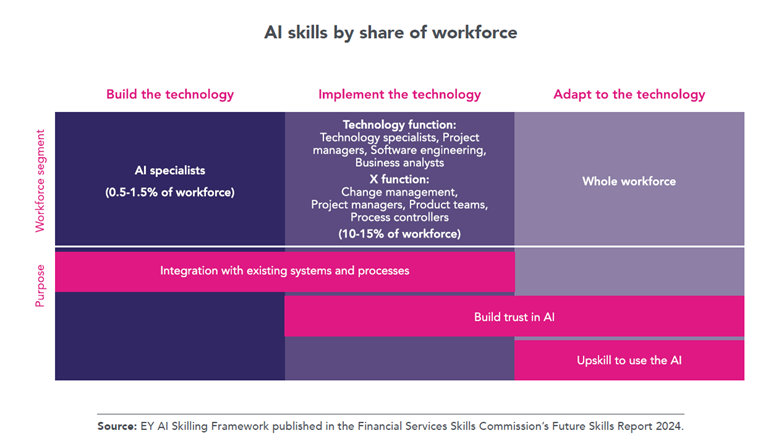
It is a difficult figure to arrive at. The model presented in our May 2025 report – Unlocking AI’s potential: The skills that matter – shows the impact of AI on a workforce and where investment in talent will be needed. The 1.5 – 15 – 85% model sets out where expertise, application and use will be needed. Actual levels of investment as a percentage would be a good aim and we will continue to explore this. Keep an eye on our research into disruptive tech!
Training seems to be becoming dehumanised through online offerings. Online seem to take away the context of the subject and also the skill of a human tutor?
Our members’ approach suggests that a mixed model is needed to ensure time-bound, ringfenced learning and learning in the flow of work. We also need to incentivise colleagues to value learning and role model different types of learning. The work we have been doing with members to look at what drives a good learning culture has focussed on this issue.
If we don’t know how roles will be affected by AI, how can we deploy a good talent strategy and training?
We don’t know what the future looks like but that’s why we must focus on skills and strategic workforce planning rather than roles. Jobs will change but the essential skill sets underlying them should be more perennial. Our Skills-Based Organisation Framework is a crucial tool for firms to begin their skills-based journey. It is a challenge but much thinking suggests that when planning an organisational or talent strategy it should be agile. It needs to be based on good strategic workforce planning. This includes regular skills forecasting and assessment linked to this planning, the ability to flex to new technologies and opportunities but built on core skillset that the organisation is growing. It’s no longer a static three-year strategy process.
What does upskilling to use AI mean in practical terms?
Depending on the role and the current use of technology within it, upskilling requirements may vary. This is really for firms to assess and plan for. The technology within systems is a good place to start (e.g. Microsoft Copilot). Often there are built-in learning options for this but more specialist systems are increasingly assisted by integrated AI. Supporting colleagues to build fundamental AI skills and knowledge (i.e. what it is, its capabilities, understanding the risks) is a good place to start. Ultimately, if an organisation is looking at skills through its strategic workforce planning, then it should be able to show where technology will be changing and support people to upskill in those areas.
Does the responsibility for developing young people’s skills in AI rest solely with schools, financial services businesses or both?
Both. Schools take children so far and deliver a young person ready for work (in the most part). Our responsibility as employers is to build the bridge to take young people into skilled and meaningful career routes and support development. Work readiness and modern work experience placements are one way of supporting this transition, as are apprenticeships. Technology is changing rapidly and it is a challenge for both educational institutions and businesses to keep pace. The idea is to work in partnership/collaboration to create learning that is agile/relevant.
What skills are needed to support an agentic ecosystem? If you believe in an agentic AI future, then how much do human relationships matter and for how long?
Human relationships will always be at the core of customer and client-led services. This is why we include relationship management in our framework alongside other skills such as creative thinking and empathy. The ‘human in the loop’ needs to oversee outputs, check and quality-control the customer experience. Also, AI agents may be able to cover an increasing number of processes but there are likely to always be circumstances where human-to-human interaction is needed. For example bereavement, more complex claims handling or complaints, leadership and coaching etc. The evolution of AI will place a premium on uniquely human qualities.
I have often heard colleagues feel like they are ‘cheating’ if they use AI tools for their work. How will we address the cultural elements of this new technology?
AI is increasingly being integrated into our workplaces. Leaders need to be role models and share their experiences of how they use it. PwC’s 2025 Global Workforce Hopes and Fears Survey indicates a significant difference between leaders and workers in their views on the adoption of artificial intelligence, training opportunities and overall optimism about AI.
What degrees remain most relevant?
We know that there is a broad pipeline of early careers talent coming from different degree courses. This is not necessarily about the degree but rather the skills, such as critical thinking, adaptability and foundational digital / AI skills. STEM subjects are important; firms will need this technical skills base but not by all. We’re going through a period of transformation and diverse perspectives, skills and creative viewpoints will be essential.
Does upskilling in AI supersede soft skills development? How many people are losing the capability to handle basic tasks because of over-reliance on AI?
We need a blend and mix of skills. We are increasingly seeing skills gaps reported by our members, which suggests that firms want more soft skills or behaviours. As work automates this may reduce technical skills gaps and put human skills back at a premium. That being said, it is important that employees have foundational digital skills so that they can use, maintain and oversee AI systems and processes.
As we move toward a more hybrid future, where humans and AI work together to complete tasks, it will be essential that people retain a solid understanding of basic tasks so they can oversee and challenge AI outputs.
Does Jersey need its own Financial Services Skills Commission?
I’ll leave that with our friends in Jersey to decide! What I do know is that the skills challenge affects the whole financial services ecosystem across the British Isles and its dependencies. Since becoming a member of the Financial Services Skills Commission, Jersey Finance have taken a proactive leadership role in addressing the challenges that lie ahead for the sector. During our time working together they have brought invaluable experience and perspectives that are helping us and our members take collective action on the sector’s skills challenges.
Do you see a tension between the ROI in upskilling people vs developing AI? On the one hand, the benefit is owned by the company and is scalable. On the other, not.
Yes, I can see the point that developing AI systems offering better ROI as the benefit is kept in-house, whereas people are free to move. However, AI systems are redundant unless you have a workforce that can use them effectively. The two go hand in hand. Additionally, a lot of AI systems are from third parties therefore you become reliant on external vendors but upskilling people means more control and developing one’s own AI solutions. Disruptive tech research has found considerable uncertainty around AI ROI at the moment, beyond productivity metrics, so this question remains TBC.

If you joined us at FINx or you’re exploring how tokenisation is moving within your organisation, you’ll find real-world use cases and market readiness to regulatory considerations and the role jurisdictions like Jersey play in enabling tokenised structures.
Thank you to the expert panellists from the event who offered further clarity and insight: Sarah Townsend, Andrew Evans, Suzanne Howe and Elliot Refson for their contributions.

The level of engagement across our inaugural FINx event made one thing clear: there is strong interest from the finance industry in the topics discussed. While we weren’t able to cover every question during the live sessions, we are addressing them as part of our FINx: Your Questions Answered series.
Andrew Morfill, one of the event’s keynote speakers, gives his insights on your stablecoin-related questions.

Thank you to the expert panellists from the event who offered further clarity and insight, namely Professor Alan W. Brown, Jill Britton, Tony Moretta and Emma German, for their contributions.