

- Jersey Finance
- |23 Oct 2026
In Conversation with Mike Capraro
What turns a compelling fund proposition into a successful launch?
8 Sep 2026

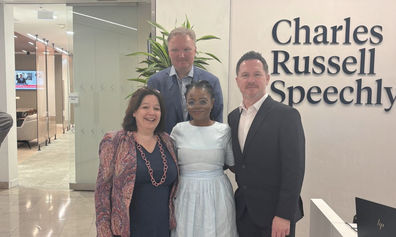
Ahead Jersey Finance’s funds-focussed roundtable in Cape Town, Dr Rufaro Nyakatawa, Director – Africa at Jersey Finance, speaks with Mike Capraro, Funds Client Director at ZEDRA, about the foundations of a successful fund launch – from securing anchor capital and building a credible track record to developing the relationships that support long-term growth.
A strong investment thesis may be the starting point for a new fund, but it is rarely enough on its own.
For emerging and first-time managers in particular, success depends on converting an idea into a proposition that investors can understand, trust and support.
In this conversation, Mike draws on more than 26 years in the investment funds industry to share the practical lessons he has learned from fund launches that have flourished, those that have stalled and those that have never made it beyond the initial concept.
From your experience, what most often makes the difference between a fund succeeding and failing?
Over time, I started to understand the critical success factors. They may not be earth-shattering revelations, but rather quite obvious.
Aspirational fund promoters invariably present compelling investment concepts, and most have a credible work history in the industry. Many spend a great deal of time and money on legal advice and set-up costs, only to fail mainly because of one critical factor: an inability to raise sufficient capital from investors.
Fund administrators are generally mindful that taking on a new fund promoter, incorporating the structure and going through the regulatory approval process, only for the fund to fail to attract investors, can create a significant liability for both the fund promoter and the fund administrator.
What do you regard as the most fundamental element of a successful fund launch?
In my experience, the most fundamental element is the commitment of one or more anchor investors, followed by raising sufficient capital more broadly to sustain the fund. Depending on the type of fund structure selected, that amount of capital can be anything from £10 million upwards. For funds raising less than this amount, it can be difficult to overcome the fixed-cost fee drag associated with managing a fund.
Before anything else, promoters need to identify their distribution channels and know where their investors will come from. They need real relationships within those identified channels that can provide access to a pool of potential investors, and they should test the appetite for the investment proposition before spending money on service providers.
Fund promoters are primarily responsible for two things: finding investors and selecting the assets of the fund. Fund administrators take care of the operational aspects. Promoters can sometimes expect an administrator to assist with fund promotion, but that has not been the case in my experience.
Why can the size of the fund be so important?
Fund administration costs can be divided into two broad categories: fixed costs and ad valorem costs. Fixed costs are incurred regardless of the size of the assets in the fund. Ad valorem costs fluctuate with the size of the assets, but are usually subject to minimum fee floors.
By way of illustration, a fund administration fee might be a fixed fee of £20,000 per annum and 10 basis points of the fund’s assets above a certain threshold. In that example, the fund’s assets would need to exceed £20 million before moving into ad valorem territory. Other examples of fixed costs include audit and regulatory fees.
This is why, when a fund promoter contacts me about establishing a new fund, the first thing I ask is: how much money do you have in hard commitments from your anchor investors? If the answer is zero, the discussion follows one path. If the answer is positive, we move into a different discussion.
Are there circumstances in which a promoter might begin with a private investment vehicle rather than a regulated fund?
There can be. Some years ago, I was introduced to a young portfolio manager. He had been employed by an investment business that failed as a consequence of the 2008 credit crunch. He had a compelling investment proposition and a demonstrable track record of experience. Importantly, he had four business partners, each willing to commit their own capital to the proposition.
The total committed capital of £2 million was insufficient to cover the establishment and ongoing costs of a fully regulated fund. The approach taken was therefore to incorporate a private company, with the five partners as proportional shareholders.
The company appointed the individual as portfolio manager and adopted an investment strategy document akin to a prospectus. It operated in many respects like a regulated fund, but without all the associated overheads. Formal valuations were undertaken twice a year to keep costs down, unless a new shareholder wished to join, when an ad-hoc valuation was performed. Annual financial statements were independently audited, providing an element of oversight while keeping costs proportionate.
Over time, the company built up an enviable performance record. More family and friends asked to become shareholders and, after 18 months, the company was transformed into a regulated fund for professional investors. Three years later, the partnership was joined by another portfolio manager with a different investment strategy, giving rise to a new fund.
The conclusion I draw from this example is that an investment proposition does not necessarily have to start life as a fully fledged regulated fund, but it does need investors and working capital. A private investment vehicle can be less expensive to establish and operate and, in the right circumstances, may evolve into a regulated fund once it has developed a track record and sufficient investor demand.
How can an existing network help a promoter develop a fund proposition?
A second example involved two highly successful entrepreneurs in the artificial intelligence infrastructure sector. Through their prior involvement in the industry, they had built an enviable network of software developers, venture capitalists and industry leaders.
Some former colleagues had established start-up companies and approached them for seed capital and mentorship. By supporting people within their network financially and technically, they accumulated shares in a number of start-ups, held through a private company of which they were the sole shareholders.
They soon realised that they had many of the elements of a venture capital enterprise. They held a number of compelling investments that they intended to transfer into their first fund as their contribution. They had a wide network of contacts on both the investor and investment sides, and venture capitalists were approaching them for new opportunities. People were prepared to back them and seek out their industry expertise.
They needed structuring advice and support with the establishment of their first venture capital fund. One of their strengths was that they knew what they were good at and acknowledged where they needed help. They took advice readily and surrounded themselves with people who augmented their skill set.
What started as a concept developed, over approximately 18 months, into a venture capital fund with around £20 million under management, which became fully invested. The momentum and infrastructure they created also led to the development of Fund II.
What are the principal lessons you draw from these two examples?
Although they are very different examples, the conclusion is clear. There are many paths that can be followed to establish a new fund, but without investor capital at the outset, the chances of success are slim.
A proposition does not necessarily have to start as a fund, but capital is needed to manage investments and build a track record. In my experience, the key considerations are whether there is an anchor investor at the outset, whether the promoter has a clear distribution strategy after launch and whether there is genuine access to those distribution channels.
There are many paths that can be followed to establish a new fund, but without investor capital at the outset, the chances of success are slim.Mike CapraroFunds Client Director at ZEDRA
Related Insights
- Jersey Finance
- |8 Jul 2026

- Jersey Finance
- |27 Mar 2026

- Jersey Finance
- |1 May 2025

- Jersey Finance
- |27 Mar 2025

- Jersey Finance
- |7 May 2024

- Jersey Finance
- |18 Apr 2024

- Jersey Finance
- |2 Feb 2024

- Jersey Finance
- |26 Jun 2023