Fintech Spotlight Series: protocol

From capture to compliance: how good data at source solves problems internally, across groups and with regulators

29 Jul 2026
protocol Consulting

We provide protocol, which is a turn-key regtech solution that streamlines compliance with end-to-end automation, delivering fast, accurate, and effortless regulatory reporting. It supports multi-jurisdiction / multi-office businesses as standard.

View profile

Ask many Compliance Officers and MLROs what the most painful part of the job actually is, and the honest answer is rarely the judgement calls. It’s the data. Compliance records assembled from email threads. Board packs stitched together from different Excel registers that don’t quite agree with each other. The difficulty is multiplied for group compliance functions trying to get a consistent risk picture across offices that each keep their own version of the truth.

The problem isn’t a lack of effort. It’s that most compliance data is captured too late, in too many places, in formats that were never designed to talk to each other. By the time it reaches a board pack or a regulatory return, someone has had to reconstruct it — and reconstruction is where accuracy, time and confidence all get lost.

It’s this problem, at its root, that Jersey-based protocol has built its platform to solve.


A case study worth noting

“Implementing protocol has had a significant positive impact across the firm. The team has experienced a noticeable improvement, making the processing and management of risk and compliance items far easier and operationally more efficient.

Producing compliance reporting and MIS is now much more efficient compared to our previous manual processes. We use the dashboards extensively, especially during board meetings, which has made compliance data far more accessible. Compliance registers are automatically populated, and we can rely on the data being complete without any re-keying or manual input.

protocol is now deployed and live across all our jurisdictions, and it’s been an invaluable tool for me in my role as Chief Risk Officer across the group”

Alex Petrie
Chief Risk Officer, Accuro

The problem with fragmented data

Compliance data problems tend to compound as they move outward from the point of capture.

First-line staff are usually the ones who know about a complaint, a breach, or a need for an exception – but that knowledge is rarely captured in a structured way at the moment it arises. It gets keyed into a word form, emailed, forgotten, chased, escalated, and eventually rekeyed into a register by someone in compliance, days or weeks after the fact. Every rekeying is a chance for detail to be lost, and every delay is a chance for something urgent to sit unactioned.

Across a group, the picture gets harder still. Multi-office and multi-jurisdictional businesses often run parallel systems, or the same system configured differently by office, with no easy way to roll individual office data up into a coherent group view. A Global Head of Compliance overseeing Jersey and half a dozen other jurisdictions shouldn’t have to reconcile multiple spreadsheets to determine what the group’s risk exposure looks like today.

Regulators, meanwhile, are asking for more – not less – structured, granular, timely data. Jersey’s own regulatory environment has moved decisively in this direction, from JFSC supervision becoming explicitly data-led, the annual risk data collection exercise, to a growing appetite for conduct-related data. Firms still maintaining risk and compliance recordkeeping manually, with disconnected local records, will find that gap increasingly hard to close.

The consequence, in each case, is the same: data that is accurate somewhere in the business, but not reliably accurate everywhere it needs to be, at the moment it’s needed.

How protocol works

protocol is built on a simple premise: capture the data properly once, at the point it’s created, and everything downstream – dashboards, registers, group reporting, regulatory submissions – takes care of itself.

Rather than depending on the quality of a firm’s existing records, protocol is data generative. It doesn’t need a clean historical dataset to work; it builds one, from the moment first-line staff begin using it. Every SAR, PEP acceptance, breach, complaint, conflict of interest, exception request and more is captured directly into the system by the person who needs to report it, in a structured form, with the record updating automatically as the matter progresses.

That single design choice is what solves all three layers of the problem at once:

Internally, compliance teams stop rekeying data from emails and spreadsheets into registers, because the register was never separate from the point of capture in the first place. Every process comes with its own dashboard and automatically maintained register – no reconciliation, no lag.

At group level, protocol is built to support multi-office and multi-jurisdiction businesses as standard. Field options – such as the grounds for disclosure on a SAR, which differ by jurisdiction – can be tailored by office while still rolling up into group-wide dashboards and reports. A compliance lead can see the group-wide picture without losing the local nuance that regulators in each jurisdiction expect to see respected.

For regulators, the result is a fully auditable trail from the moment a matter is first raised to its resolution – exactly the kind of evidenced record that satisfies examination scrutiny, and one that scales naturally as reporting expectations continue to rise.

Because protocol’s data is always stored within the client’s own IT environment – on-premises or in the client’s own cloud tenancy – this also means firms get the benefits of a connected, group-wide dataset without ceding control of where that data lives.

protocol, in practice: Core and Core+

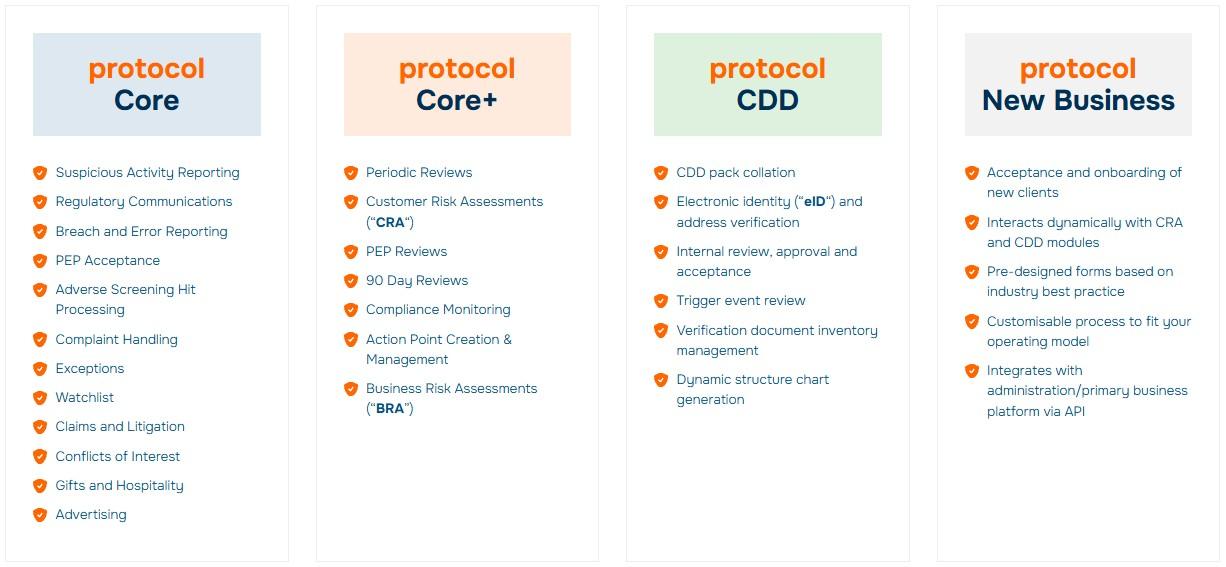
protocol Core manages the regulatory and AML non-negotiables every regulated firm must run – SARs, breaches, PEP acceptance, conflicts, complaints and more – each captured as a structured form, mapped to a defined process, and backed by its own dashboard and register.

protocol Core+ builds on that foundation, delivering powerful and flexible automated Periodic Reviews, Customer Risk Assessments, PEP Reviews, Compliance Monitoring and Business Risk Assessments.

Built for what’s coming, not just what’s here now

There’s a longer-term dimension to this too. A compliance function’s ability to do anything more sophisticated with its data – trend analysis, predictive risk indicators, AI-assisted analytics – depends on that data being clean, structured and complete in the first place. You cannot run meaningful intelligence over a dataset that’s scattered across inboxes and spreadsheets.

By generating consistent, organised and full real-time compliance data as a by-product of everyday first-line activity, protocol builds exactly the foundation that any future intelligence layer – human or machine – would need. Firms getting their data architecture right now are the ones best placed to make use of whatever comes next.

A Jersey-grown regtech solution, solving a problem regulators and boards both feel

protocol’s relevance to Jersey’s regulatory environment isn’t incidental – it was built by practitioners who have held Principal Person roles, been in the regulatory hotseat themselves, and operated client administration teams in funds and trust businesses for decades. That’s shaped a platform designed around the actual mechanics of first line and second line responsibility, not a generic workflow tool retrofitted for compliance.

The pressures driving this – rising regulatory data expectations, greater group structures within an increasingly consolidating financial services industry, and boards on the regulatory hook needing real assurance rather than a quarterly assembly of spreadsheets – aren’t going away. Firms that keep solving these challenges with manual, fragmented, after-the-fact reporting will find the gap between what they can produce and what’s expected of them keeps widening.

protocol’s approach offers a different starting point: get the data right at the moment it’s created, and internal reporting, group oversight and regulatory confidence all follow from the same source.

To learn more about protocol, visit protocol-consulting.com or get in touch to arrange a demonstration.