- Jersey Finance
- |6 Nov 2026
Sustainable Finance
We believe Jersey, as a leading international finance centre, has a responsibility to leverage its expertise and capital to support the transition to a more environmentally and socially sustainable global economy.
This hub offers practical insights, guidance, and examples to support firms as they integrate sustainable principles into their strategies and operations.
Sustainable finance resources
Our sustainable finance resources bring together a collection of events, videos, and thought-leadership papers to support our Members’ understanding of sustainable finance.

- Jersey Finance
- |3 Sep 2026

- 1 Dec 2026
- |Microsoft Teams
- Jersey Finance
- |14 Aug 2026

- Cazenove Capital
- |1 Sep 2026

- Jersey Finance
- |12 Aug 2026

- Cazenove Capital
- |1 Sep 2026

- Carey Olsen
- |6 Aug 2026

- Lloyds Bank International Limited
- |27 Aug 2026

- Jersey Finance
- |4 Jun 2026

- Jersey Finance
- |30 Jul 2026
- Jersey Finance
- |30 Apr 2026
Sustainable finance is part of everything we do
The global financial system is changing powered by global mega-trends. From societal pressures to increased regulatory intervention in support of global policy commitments, sustainable finance is experiencing strong growth.
The shift in private capital towards activities supporting a sustainable future is essential to tackle the world’s most pressing issues.
Globally, ESG assets are predicted to exceed US$100 trillion by 2028 and US$150 trillion by 2034 (Deutsche Bank and GSIA).
With our sustainable finance strategy to catalyse action, Jersey is well placed to embed sustainable finance across its financial services sectors. Our legal and professional service providers are developing new services – whether in terms of assurance, regulatory compliance, or supporting clients to list on innovative sustainable exchanges like TISE Sustainable. To ensure that our sustainable finance credentials are built on trust and integrity, in 2021 Jersey introduced a proportionate disclosure framework to mitigate the risk of greenwashing.
We have the solid foundations to support businesses and investors with their sustainable finance goals.
Finance solutions and sustainable finance

Private Wealth >
As intergenerational wealth transfers drive demand for investment strategies that focus on purpose and impact as well as transparency and profitability, private wealth is playing a vital role in supporting the global shift towards sustainable finance.

Funds >
Fund managers are increasingly focussed on sustainable investment principles bringing their products, domiciliation and service provider choices in line with sustainable investing criteria, to enhance returns, manage risk and differentiate their offering. Jersey can support with innovative solutions such as data-driven reporting to meet the increasing demand for ESG disclosure from investors and regulators.

Banking >
Jersey’s banks are also embracing sustainable finance by expanding their range of sustainable lending products and embedding global standards such as the Principles for Responsible Banking (PRB) into their business models.

Investment Management >
The inclusion of ESG factors in mainstream investment planning has accelerated significantly in recent years, with asset owners and managers adopting a range of approaches that are broadly described as responsible investing.

Fintech >
With a thriving fintech sector, Jersey is in a strong position to capitalise on advances in digital technology that can be used to scale up ESG data solutions and drive developments in sustainable finance.

Corporate Services >
Our corporate service providers continue to develop new ways to support Jersey’s transition to sustainability – from standardising ESG reporting to helping clients list on forward-thinking stock exchanges like TISE Sustainable.
ESG investing spectrum
At the core of sustainable finance, ESG investing allows for consideration of environmental, social and governance factors, alongside financial factors in the investment decision-making process. The ESG investing spectrum ranges from negative screening (where the primary focus is to achieve a financial return, while also making a positive impact) to impact investing (where the primary focus is to achieve a positive impact, while also making a financial return).
Negative screening
Exclude certain investments from a portfolio, based on specific ESG criteria (e.g. tobacco companies)
ESG Integration
Include ESG credentials as a factor when performing the financial analysis of an investment
Norms-Based Screening
Screen investments to ensure their minimum standards of business practice meet international norms and standards (such as those issued by the OECD, UN and UNICEF)
Positive Screening
Invest in sectors, companies or projects which have the best ESG practices amongst industry peers
Sustainability-Themed Investing
Invest in sectors, companies or projects specifically related to sustainability (such as clean energy, green technology or sustainable agriculture)
"Pure" Impact Investing
Invest in sectors, companies or projects which will have the greatest social or environmental impact
Sustainable finance courses
Develop your sustainable finance knowledge and skills with a range of courses covering ESG, climate risk and sustainable investment. Scroll through the carousel below to explore your options.
By 2030, Jersey will be recognised by its clients, key stakeholders and other partners as the leading sustainable international finance centre in the markets it serves.Jersey FinanceOur Vision and Strategy for Sustainable Finance

Sustainable Finance Questions
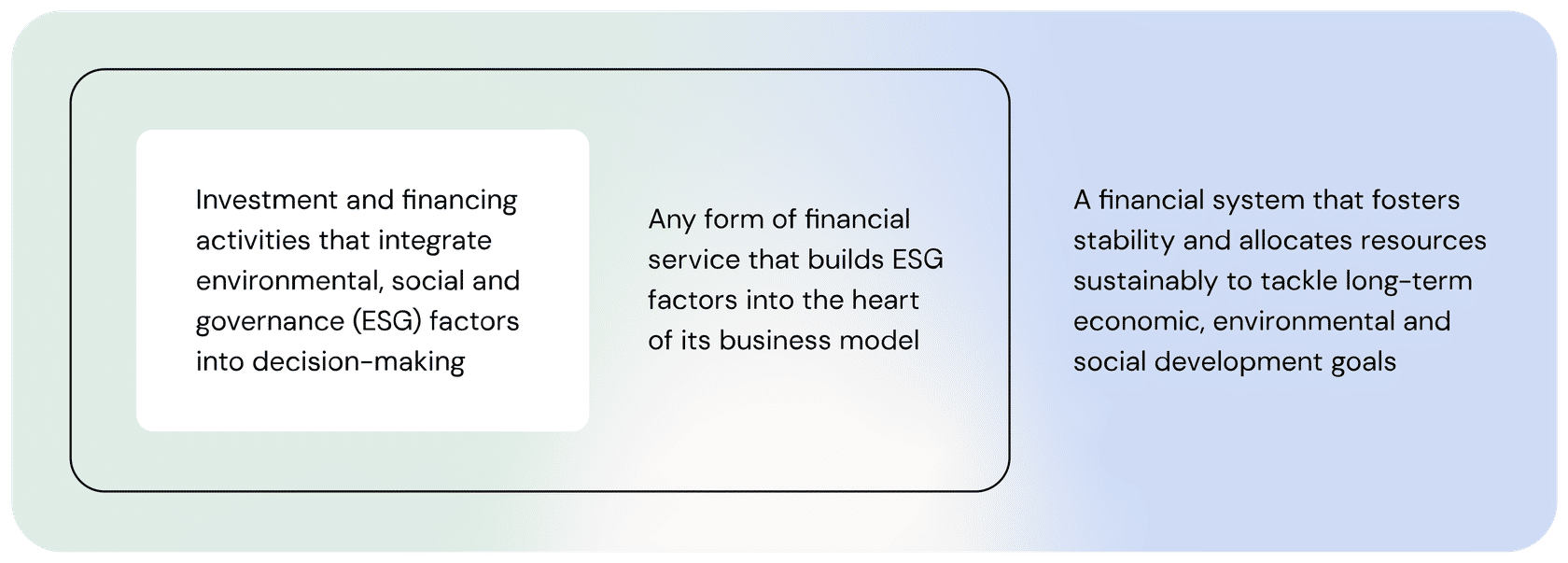
What is sustainable finance?
The process of taking environmental, social and governance (ESG) considerations into account when making investment decisions in the financial sector, leading to more long-term investments in sustainable economic activities and projects.
In the EU’s policy context, it is understood as “finance to support economic growth while reducing pressures on the environment and taking into account social and governance aspects.”
A system-wide view: